
Engine Protection · In-Depth Review
Most oil additives wash out the moment you drain your oil. Ceratec doesn't - it bonds to the metal and stays. Here's how the ceramic technology actually works, why it holds up so well in Pakistani driving, and why genuine stock is so hard to get hold of.
The honest answer
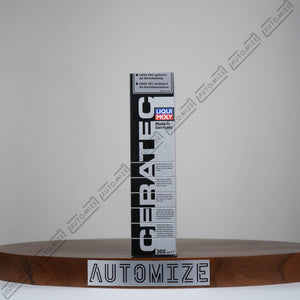
Ceratec is a German-made ceramic wear additive that reacts with your engine's metal surfaces and keeps protecting them for up to 50,000 km — across several oil changes. At Rs. 8,800 it isn't an impulse buy, but for an engine you plan to keep for years, the cost works out to less than what you'd spend on a couple of proper car washes a year.
What's inside
Why Pakistani drivers keep coming back to this bottle
Walk into any serious car conversation in Pakistan be it a Civic owners' group, a Land Cruiser forum thread, a workshop that actually knows its stuff, and Liqui Moly's Ceratec comes up. There's a reason it has a cult following here, and it isn't marketing.
Most cars on our roads fall into one of two camps. Either they're reconditioned Japanese imports where nobody truly knows the engine's history, or they're cars owners intend to hold onto for eight, ten, sometimes fifteen years. Both situations share the same worry: keeping an engine healthy over a long life, often on fuel and servicing that isn't always consistent.
That's the gap Ceratec fills. It isn't a fuel-economy gimmick or a quick engine flush you run once and forget. It's a wear-protection product; something you add to buy your engine's internals more time. In a market where people genuinely keep their cars, that pitch lands differently than it would somewhere people trade in every three years.
What Ceratec actually is — the technology
Here's where Ceratec separates itself from the shelf full of additives at your local parts shop. Most additives do one thing. Ceratec does two at once. Liqui Moly describes it as a suspension of a micro-ceramic solid lubricant combined with chemical active agents, carried in a base oil. In plain terms, two different protective mechanisms work together in the same bottle.
Nothing about the metal changes — the peaks are identical in both panels. What changes is the gaps between them. Fill those, and the load spreads across a flat surface instead of hammering a few sharp points.
The mechanical half — ceramic particles
No metal surface is truly smooth. Zoom in far enough and even a polished camshaft looks like a mountain range of tiny peaks and valleys. When two of these surfaces slide against each other, those rough points grind and wear. Ceratec's ceramic particles, having graphite-like structure, settle into those microscopic gaps and fill them in, so the surfaces glide instead of grinding.
The chemical half — the friction modifier
The second component is a chemical agent that smooths the metal without scraping it away. It uses the engine's own friction energy to gently level the high points on the metal. So while the ceramic fills the low spots, the chemical modifier tidies up the high spots. Together, they create a genuinely smoother surface for oil to work across.
A few technical details worth knowing, because they matter in real use:
- The ceramic particles average about 1 micrometre in size — small enough to pass through your oil filter without clogging it. Cheap additives often fail exactly here; Ceratec is engineered around it.
- It's thermally and mechanically stable, so it keeps working under sustained load and heat.
- One 300ml aluminium can treats 3 to 5 litres of oil — about 6% of your total oil volume — covering most passenger car engines with a single bottle.
There's also independent testing behind it, which is rare in the additive world. Liqui Moly had the product tested by APL, a neutral German testing house. On a gear-wear test bench, reference oil failed at damage force level 4. The same oil with 6% Ceratec added held on to level 9 — more than double the load before failure. You can read Liqui Moly's own write-up of the test and technology on their official Cera Tec page.
The 50,000 km claim, explained
This is the part that gets misunderstood the most, so let's clear it up properly. Liqui Moly's official figure is protection up to 50,000 km (30,000 miles). The reason it lasts that long is the ceramic component reacts directly with the metal surface — so unlike a simple lubricant that floats in your oil, the ceramic protection stays behind on the metal even after you drain the old oil.
| Stage | What happens |
|---|---|
| You add Ceratec to fresh oil | Ceramic begins reacting with and bonding to metal surfaces |
| First few hundred km | Protection builds as the engine goes through heat cycles |
| Next oil change | Old oil drains — the bonded ceramic layer stays on the metal |
| Following oil changes | Metal stays protected without a fresh dose |
| Around 25,000–30,000 km | Practical point to re-treat under Pakistani conditions |
Now the honest nuance. The manufacturer's maximum is 50,000 km, but Liqui Moly also recommend re-dosing at each oil change for the strongest protection. In Pakistan — where fuel quality swings from pump to pump and oil often gets changed on the shorter side — the sensible middle ground most experienced users land on is re-treating every 25,000 to 30,000 km, roughly every two to three oil changes. That's the figure worth planning around here.
On cost, the maths is friendlier than the sticker suggests. One Rs. 8,800 can covering ~30,000 km works out to under Rs. 3,000 per year for someone driving 15,000 km annually — modest, for a product whose whole job is protecting the single most expensive part of your car.
Liqui Moly Ceratec vs. Liqui Moly MoS2
This is the comparison people actually search for, and most sellers dodge it. Both are excellent Liqui Moly wear-protection additives — they just use completely different technology and suit different engines.
MoS2 (molybdenum disulfide) is Liqui Moly's original — the product that built the company over 60 years ago. It's a solid lubricant: microscopic MoS2 particles coat the metal and create a slick, low-friction film. It works fast, often quieting a noisy engine within a drive or two. The trade-off is that it drains out with the oil, so you top it up at every change. On Automize it's Rs. 3,250.
Ceratec is the modern, longer-game option — the ceramic-plus-chemical formula we've broken down above, built to last across oil changes.
| Ceratec — Rs. 8,800 | MoS2 Oil Additive — Rs. 3,250 | |
|---|---|---|
| Core technology | Micro-ceramic + chemical modifier | Molybdenum disulfide solid lubricant |
| Survives oil changes | Yes — up to 50,000 km | No — reapply each change |
| Best suited to | Modern, turbo, low-viscosity-oil engines | Older, higher-mileage, noisier engines |
| How results feel | Builds gradually over a few hundred km | Often noticeable within the first drive |
| Manual gearbox use | Yes | Yes |
Quick guide by what you drive
- Alto, WagonR, Cultus, older Mehran — high mileage, simpler engines: MoS2 is the practical, budget-friendly pick.
- Corolla, City, Civic (2018 onward), Sportage, Tucson — newer engines on thinner oils: Ceratec is the better technical match.
- Turbocharged engines — Civic RS, Fortuner, Haval H6, BYD — run hotter and tighter: Ceratec is the clear choice.
- Manual gearbox that shifts notchy: either works; Ceratec lasts longer between doses.
- Karachi commuters clocking long daily distances, or M2 regulars between Lahore and Islamabad: Ceratec suits sustained, high-load running.
Don't mix Ceratec and MoS2 in the same oil change. Use one or the other per interval.
How to use Ceratec the right way
Simple product, but people still get it wrong. Get this right and it does its job properly.

- Shake the can well before opening as the ceramic needs to be evenly suspended.
- Add it to fresh oil, ideally right after an oil change; not into old, contaminated oil near the end of its life.
- One full 300ml can per 3–5 litres of oil. Most passenger engines need just the one.
- Don't combine it with MoS2 in the same change.
- Let the engine idle a few minutes after adding, then drive normally; the ceramic bonds over the first few hundred km, so full effect takes a little time.
Ceratec is not for DSG/DCT gearboxes, conventional automatics, or wet clutches (including most motorcycles that share engine and gearbox oil). It's built for 4-stroke petrol and diesel engines and manual gearboxes, and is safe with turbochargers, catalytic converters, and DPF/GPF filters. It protects against wear; it won't repair an engine that's already worn out.
Why genuine Ceratec is hard to find here
Worth being upfront about this, because it affects you as a buyer. Liqui Moly is one of the most counterfeited oil brands in the region, and additives are an easy target. Random marketplace listings and unverified workshop shelves can't always vouch for where their stock came from, and a fake ceramic additive is worse than useless, since you're pouring an unknown liquid into your engine on the promise of protection.
Ceratec is also a slow, considered purchase rather than a fast-moving item, so it doesn't get restocked in the volumes a shampoo or a wiper blade would. Automize keeps genuine, authenticated stock, but quantities stay deliberately limited for exactly that reason. If it's showing in stock, that's the moment to grab it — those windows don't stay open long.
Get genuine Ceratec while it's in stock
Authenticated German stock, delivered across Pakistan. Limited quantity.
Buy Ceratec at AutomizeFAQ
Can I use Liqui Moly Ceratec in a Suzuki Alto or Cultus? +
Yes — it's safe in these engines. That said, for older, high-mileage small cars, the cheaper MoS2 additive often makes more sense for the money. Ceratec really earns its price in newer or harder-worked engines.
Does Ceratec work with synthetic oil? +
Yes. It's miscible with all commercially available engine oils — mineral, semi-synthetic, and fully synthetic. It mixes in on its own; no special procedure needed.
Can I put it in my manual gearbox? +
Yes. Ceratec is designed for manual transmissions as well as engines. Match the dose to your gearbox oil capacity. Do not use it in automatics, DSG/DCT, or anything with a wet clutch.
Do I need to add it at every oil change? +
Not necessarily. The ceramic protection lasts up to 50,000 km, so it carries across oil changes. For Pakistani conditions, re-treating every 25,000–30,000 km is a sensible rhythm. Liqui Moly notes that dosing every change gives maximum protection if you prefer that.
How is this different from the cheap additives at local workshops? +
Two things: verifiable technology and independent testing. Ceratec's ceramic-plus-chemical formula is documented, filter-safe at around 1 micron, and was validated by a neutral German test house. Most cheap additives offer none of that, and many are outright counterfeits.
Is Ceratec available in Lahore, Karachi, and other cities? +
Yes — Automize delivers genuine Ceratec across Pakistan, including Lahore, Karachi, Islamabad, Rawalpindi and beyond, subject to stock. Because quantities are limited, availability moves quickly.
Share:
How to Safely Maintain Hybrid Cars in Pakistan (2026)
Gyeon in Pakistan: The Korean Ceramic System Built to Protect Your Coating & PPF