
- Your interior isn't one surface. It's fabric, plastic and leather — three materials with three completely different needs.
- Clean → Dress → Condition. MZR strips the grime, Top Star protects the plastics, Leather Star feeds the hide.
- MZR Rs.4,300 · Top Star Rs.5,550 · Leather Star Rs.7,200 (1 litre each)
- A full reset takes an afternoon. Maintenance takes about twenty minutes a month.
- Written for owners doing it themselves — and for detailers who want the dilution numbers without the guesswork.
You wash the outside for other people. You clean the inside for yourself.
Think about how that actually plays out. The paint gets the wax, the two-bucket wash, the Sunday morning, the photo.
Meanwhile the part of the car you genuinely live in, the part your hands touch every single day, the seat your kid falls asleep in on the way back from Murree, the dashboard you stare at through an hour of Shahrah-e-Faisal traffic, gets a dry cloth and a hopeful wipe.
And here's the cruel part: interiors don't get dirty overnight. They fade. Slowly enough that you stop noticing, until one day a friend sits in your passenger seat and you suddenly see the whole thing through their eyes. Grey, chalky dashboard. A shine on the driver's seat bolster that definitely wasn't there in the showroom. That vague, unplaceable dullness.
The good news is that this is fixable, and it's fixable with a system rather than a miracle. Most car interior cleaning products in Pakistan are sold as one-bottle-does-everything sprays, which is exactly why your interior still looks tired after you've used them. Three enemies are at work in your cabin — the sun, the dust, and us — and each one needs a different answer.
Why Car Interiors Age Faster Than You Think
Before the products, the problem. Because once you understand what's actually happening to your cabin, the fix stops feeling like a shopping list and starts feeling obvious.
The sun is doing chemistry, not just heating
Your windscreen filters some ultraviolet light, but not all of it, and side glass filters even less. What gets through doesn't just warm the dashboard; it breaks it.
The process is called photodegradation. UV energy snaps the molecular chains inside the polymers your dashboard, door cards and console are moulded from. As those chains break, the material's properties change: it loses flexibility, the surface roughens, colour shifts, and eventually you get the chalky, faded, micro-cracked finish that no amount of wiping will bring back.
A faded dashboard isn't dirty. It's damaged. Cleaning won't fix it, which is why prevention beats rescue every time.
Dust isn't dust — it's abrasive
Fine particulate settles into the textured grain of your plastics and works its way deep into the weave of fabric seats. Every time you drag a dry cloth across a dusty dashboard, you're not cleaning it. You're lightly sanding it.
Over a few years of that, the factory grain gets polished flat in the places you touch most, which is why worn dashboards develop those subtly shiny patches near the vents and the instrument binnacle.
And then there's us
We're the third enemy, and honestly the least glamorous one.
- Skin oils transfer constantly from hands, arms and the back of your neck to the steering wheel, gear selector, armrest and headrest.
- Hair product and sunscreen leave a film on door cards and the A-pillar.
- Food, drinks, and whatever your passengers have decided to do in there.
Leather is especially good at absorbing body oil because it's a hide, it's designed to absorb things. That absorbed oil is what turns a driver's seat bolster dark and glossy while the passenger seat next to it still looks new.
Why this stacks up quickly on local driving patterns
Cars here work hard in a specific way. Long idle periods in stop-start traffic mean the cabin heat-soaks for extended stretches rather than cooling on the move. A car parked in an open office lot from nine to five is accumulating UV exposure on eight-hour shifts, five days a week. And routes with heavy road dust load the interior far faster than the manufacturer's maintenance intervals ever assumed.
None of which is a disaster. It just means the intervals that work in Stuttgart need adjusting for how we actually drive.
One Bottle Can't Do Three Jobs
Here's the realisation that changes everything: your car interior isn't a surface. It's three surfaces.
There's fabric — seats, carpets, the roof lining. There's plastic and rubber — the dashboard, trims, consoles, door seals. And there's leather, which behaves nothing like either of the other two.
These materials want opposite things. A cleaner is designed to strip contaminants away. A dressing is designed to leave a protective layer behind. A conditioner is designed to be absorbed into the material and stay there. Ask a single all-purpose spray to do all three and it will do all three badly; usually by leaving a slightly greasy film on everything, which then attracts dust, which is how people end up cleaning their interior more often and enjoying it less.
So instead: three jobs, in order.
- Clean. You cannot protect a dirty surface. Anything applied over grime just seals the grime in and locks it there.
- Dress. Plastics need a UV barrier and an anti-static finish that repels dust rather than collecting it.
- Condition. Leather needs moisture and flexibility from within, not a coating on top.
The order isn't negotiable, and it's the single most common thing people get wrong.
Step One — MZR, the Reset Button
If there's one product in this trio that produces the dramatic before-and-after, it's this one. MZR is what takes a car back to roughly how it looked before you owned it — call it eighty per cent of new, achieved in an afternoon.
What it actually is
MZR — short for Mehrzweckreiniger, which is German for "multi-purpose cleaner," and yes, the Germans really do name things exactly what they are, it is a highly effective alkaline intensive cleaner. It runs at pH 12.5 and carries Daimler approval, which is the kind of credential that matters more than any marketing claim: it means a car manufacturer has tested it against their own materials and signed off.
Why does alkaline matter? Because alkaline chemistry excels at breaking down oils, greases and organic soiling; which, as we established above, is precisely what accumulates inside a cabin. Body oils, food residue, nicotine, soot, road grime. MZR dissolves that soil and, crucially, holds it in suspension so it lifts away with your towel instead of redepositing somewhere else.
Where it earns its money
- Roof linings and headliners — the surface everyone is scared to touch, and the one that transforms a cabin most dramatically when it comes clean.
- Fabric seats and carpets — including the ground-in grime that a household upholstery spray gives up on.
- Door cards, plastics and boot linings.
- The difficult stuff — ink, soot, nicotine staining, and grease that's had years to set.
"So is this the same as Green Star?"
Fair question, and it's the one detailers ask most.
Green Star is the exterior heavyweight; an aggressive degreaser built for engine bays, wheel arches and door jambs, and designed to be rinsed off. MZR is its interior-minded sibling. It leaves out some of the harsher degreasing agents specifically so it's kinder to interior materials, it's built for surfaces that never get rinsed and then sit sealed inside a hot cabin all day.
Green Star outside. MZR inside.
Dilution is the entire skill
MZR is a concentrate with a dilution range from 1:5 all the way to 1:50, and that range is the product. Used properly, one litre becomes up to fifty-one litres of working solution, which is why a professional-grade bottle turns out to be cheaper per use than the ready-mixed spray you were comparing it to.
How to use it well
Mix to the appropriate strength and apply with a spray bottle or, better, a foam sprayer. Foam is the professional's choice for a reason: it clings where you put it, gives you controlled dwell time, and doesn't drip — which matters enormously on a headliner, where over-saturation runs down onto your freshly cleaned dashboard. The Koch Chemie Volumetric Foamer Bottle at Rs.2,450 does this job properly.
Let it dwell briefly, agitate with a soft interior brush or microfiber towel, then remove residue with a damp cloth or an extractor.
Two manufacturer cautions worth respecting: don't apply it to hot surfaces, and don't let it dry on the surface. Work panel by panel and you'll never run into either.
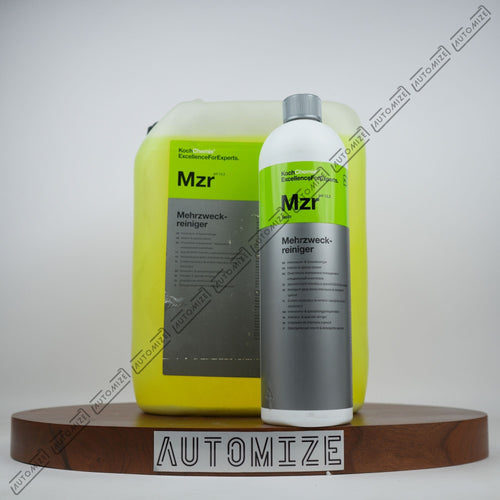
Alkaline intensive cleaner, pH 12.5, Daimler approved. Dilutes 1:5 to 1:50 for fabric, carpets, headliners and interior plastics.
Step Two — Top Star, and the Death of the Greasy Dashboard
Everybody has used a dashboard dressing that made things worse. You know the one. It goes on wet, it looks impressive for about four hours, it throws glare up into your windscreen at exactly the wrong angle, and by Wednesday it has collected a layer of dust so devoted it looks like the dashboard is growing fur.
Top Star is the correction to that entire category.
The OEM finish argument
Top Star is a premium care emulsion that leaves a long-lasting, semi-matte, natural sheen. Not shine — sheen. The goal is not to make your dashboard look wet. The goal is to make it look the way it looked in the showroom.
This is a genuine aesthetic distinction, and once you see it you can't unsee it. Gloss reads as treated. Satin reads as new. Every manufacturer finishes interior plastics in a low-sheen texture for a reason, it's what expensive looks like, and it's what doesn't reflect into your eyeline on a bright afternoon.
UV protection, doing the thing we described earlier
Remember photodegradation? This is where we do something about it. Top Star lays down a protective layer over the plastic that shields it against UV radiation and fresh dirt, and its active ingredients keep the plastic supple rather than letting it go brittle.
You're not restoring damage here — you're preventing it. The dashboard you protect this year is the dashboard that still looks right in five years. Like most protection, it's boring until the day you compare your car to an identical one that never got it. Koch Chemie holds Daimler approval on this one too.
Anti-static is the feature nobody advertises properly
Top Star has an anti-static effect, which means treated surfaces actively repel dust rather than attracting it.
On dust-heavy routes, this is arguably the most valuable property in the bottle. It doesn't just mean your dashboard looks clean, it means it stays clean, and you clean it less often. The product that reduces how much work you have to do is the product that actually gets used.
Where to use it, and where not to
Being straight about the limits matters more than overselling the strengths.
Yes
- Dashboard, instrument surrounds, centre console
- Door cards and interior trim
- Rubber door seals, which love the conditioning
No
- Steering wheel, gear selector, pedals — anywhere grip is a safety matter
- Screens and polycarbonate displays
Application
Shake well. Pour onto a soft applicator or microfiber cloth, never directly onto the surface. Spread evenly, let it absorb, then gently level it with a clean microfiber for a consistent finish.
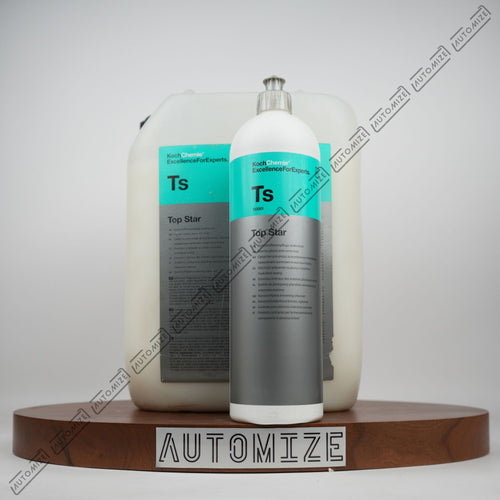
Semi-matte OEM finish with UV protection and an anti-static, dust-repellent effect. Daimler approved. For dashboards, trim, consoles and seals.
Step Three — Leather Star, Because Leather Is Skin
Leather is the surface you actually feel. You don't touch your paint. You touch your seat every day, for years. And a cracked, hardened bolster is the single fastest way a genuinely nice car starts to feel old.
First, the important distinction
Leather Star is a conditioner, not a cleaner. This trips people up constantly, so let's be unambiguous about it. Cleaning and conditioning are two separate jobs, done in sequence:
- Clean the leather with a pH-neutral cleaner — MZR is the one designed for it. Wipe with a damp cloth, then dry thoroughly.
- Then condition it with Leather Star.
Skip step one and you're not feeding the leather. You're feeding the dirt sitting on top of the leather, and sealing it in for good measure.
Why water-based matters more than it sounds
A water-based conditioner absorbs into the hide rather than sitting on top of it as an oily film. That single property is responsible for almost everything people like about this product:
- No greasy residue. Several detailers describe applying it and briefly wondering whether anything came out of the bottle, then noticing the difference an hour later.
- No slipperiness. Koch Chemie specifically formulates against it, which matters on a seat you slide across every morning and a steering wheel you'd like to keep hold of.
- No artificial gloss. The finish is a natural semi-gloss with a colour-intensifying effect; your leather looks richer and deeper, not shinier.
Safe on perforated and ventilated leather
If your car has perforated or ventilated seats, you've probably been nervous about putting anything on them, and rightly so; a thick, oily conditioner can clog the perforations and defeat the ventilation you paid extra for.
Koch Chemie states outright that Leather Star is formulated for smooth, suede and perforated leather. That's manufacturer-level assurance rather than a retailer's guess, and it's the reason this bottle ends up in a lot of professional kits.
What it's actually doing in there
- Keeps the hide supple and hydrated, which is what resists cracking; leather cracks because it dries out and loses flexibility, not because it wears through.
- Uses cosmetic-grade active ingredients for prolonged protection against fresh dirt and brittleness.
- Adds UV protection to a material that fades and hardens under sunlight just as readily as plastic does.
The scent divides people. Most find it fresh and pleasant. A minority find it slightly clinical for the first day or so; before it settles down and disappears entirely within about forty-eight hours. We'd rather tell you that than have you discover it yourself and wonder what else we left out.
Application
Clean first, dry thoroughly, shake the bottle, then apply evenly and generously across the leather with a soft microfiber cloth or sponge. Work it in with light circular motions and let it dry.
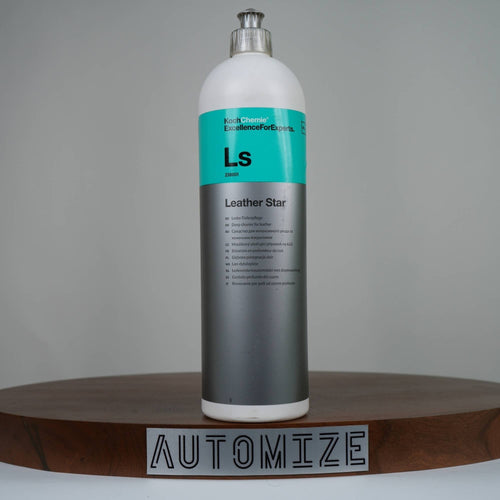
Water-based conditioner with a natural semi-gloss finish. Safe on smooth, suede and perforated leather. Non-greasy, non-slippery, colour-intensifying.
The Range at a Glance
| Product | The job it does | Surfaces | Finish | Size & price |
|---|---|---|---|---|
| MZR | Deep clean | Fabric, carpets, headliner, plastics | Clean, residue-free | 1 L — Rs.4,300 11 L — Rs.33,500 |
| Top Star | Dress & protect | Dashboard, trim, consoles, seals | Semi-matte OEM | 1 L — Rs.5,550 10 L — Rs.48,500 |
| Leather Star | Condition & preserve | Smooth & perforated leather | Natural semi-gloss | 1 L — Rs.7,200 |
| Pol Star | Clean leather & Alcantara | Leather, Alcantara, textiles | pH-neutral, no residue | From Rs.4,800 |
A Full Interior Reset, Start to Finish
Set aside an afternoon. Park somewhere shaded, because working on hot surfaces is the enemy of every product here.
- Strip and vacuum. Mats out, seats slid fully forward and then fully back. Vacuum everything, including the rails you've never looked at.
- Dry-brush the plastics. A soft detailing brush lifts settled dust out of the textured grain before anything wet turns it into paste.
- MZR the fabric and headliner. Dilute to strength, foam it on, dwell briefly, agitate gently, extract or blot. Work panel by panel. Headliners get the lightest touch you can manage; the adhesive behind the fabric doesn't appreciate saturation.
- MZR the plastics and door cards. Lighter dilution, spray onto the towel, agitate the grain, wipe clean.
- Let everything dry completely. This is the step everybody skips, and it's why finishes come out patchy. Open the doors and go and have chai.
- Pol Star the leather. Clean, wipe with a damp cloth, dry thoroughly.
- Top Star the dash and trim. Onto the applicator, never onto the surface. Even coat, absorb, level.
- Leather Star the seats. Even, generous, worked in, left to dry.
- Glass absolutely last. Every previous step throws something onto it. Do it first and you'll do it twice.
Everything above is on the shelf if you'd rather skip the trial and error — the full Koch Chemie range is stocked and ships nationwide.
How Often Should You Actually Do This?
| Task | Frequency | Product |
|---|---|---|
| Quick dust wipe-down | Weekly | Damp microfiber |
| Plastics dressed | Every 4–6 weeks | Top Star |
| Leather conditioned | Every 6–8 weeks | Leather Star |
| Full deep clean | Twice a year | MZR (+ Pol Star) |
A note on those intervals: they sit at the shorter end of general manufacturer guidance, deliberately. Protection intervals are written for cars that spend their lives garaged and driven on clean roads. If your car is parked outdoors through a full working day and covering dust-heavy routes, the protective layer is working harder and depleting faster. Treating it every four to six weeks rather than every eight or ten is the difference between maintaining a finish and rescuing one.
If your car genuinely lives in a garage and only comes out at weekends, stretch these out. You'll know.
Five Mistakes That Undo All Your Work
- Dressing a dirty dashboard. You haven't protected it. You've laminated it.
- Spraying directly onto the surface. Overspray lands on glass, screens and pedals — three places it should never be. Applicator first, always.
- Bringing a degreaser to a headliner. Products built for engine bays are built for surfaces that get rinsed. Your roof lining does not get rinsed.
- Dressing the steering wheel. Then discovering, at a roundabout, exactly why the manufacturer advised against it.
- Conditioning leather you haven't cleaned. You're not nourishing the hide. You're preserving the dirt on it.
Three bottles. Three jobs. One cabin that feels new again.
Genuine Koch Chemie, sourced properly and delivered anywhere in Pakistan.
Shop the Koch Chemie Dream TeamNot sure where to start? Message our team on WhatsApp and we'll tell you honestly which one your car actually needs — even if that's just one bottle.
Frequently Asked Questions
What's the difference between Koch Chemie MZR and Green Star?
Green Star is an aggressive alkaline degreaser built for exteriors — engine bays, wheel arches, door jambs — and it's designed to be rinsed off. MZR leaves out some of those harsher degreasing agents so it's safer on interior materials, works on surfaces that never get rinsed, and has a far more pleasant scent for working inside a closed cabin. Green Star outside, MZR inside.
Is MZR safe on car roof lining and headliners?
Yes — vehicle roof linings are among the surfaces Koch Chemie lists for it. Use a light dilution, apply with a foam sprayer rather than a soaking spray, and agitate gently. The risk with any headliner is over-saturation reaching the adhesive behind the fabric, so restraint matters more than product strength.
What is the price of Koch Chemie Top Star in Pakistan?
Top Star is Rs.5,550 for the 1-litre bottle and Rs.48,500 for the 10-litre, available at Automize with nationwide delivery. Since it's used undiluted but applied thinly via an applicator, a single litre covers a very large number of interiors.
Can Leather Star be used on perforated or ventilated leather seats?
Yes. Koch Chemie formulates it for smooth, suede and perforated leather specifically. Because it's water-based and absorbs into the hide rather than sitting on top as an oily film, it won't clog perforations the way heavy grease-based conditioners can.
Is Leather Star a cleaner or a conditioner?
A conditioner. It nourishes, protects and enriches leather that has already been cleaned — it isn't designed to lift dirt. Clean first with a pH-neutral leather cleaner such as Pol Star, dry the surface thoroughly, then condition with Leather Star.
Do I need all three, or can I start with one?
Start with whichever solves the problem you actually have. If your interior is dirty, start with MZR. If it's clean but the dashboard looks faded and dusty, start with Top Star. If your leather feels dry or is starting to look tired, start with Leather Star. The three work as a system, but none of them requires the others to be worth using.
How long does a 1-litre bottle actually last?
Longer than you'd expect. MZR is a concentrate diluted between 1:5 and 1:50, so a litre yields up to fifty-one litres of working solution. Top Star and Leather Star are used undiluted but applied in thin coats via an applicator — most owners doing their own car will get a year or more out of a bottle, which is why professional-grade products usually work out cheaper per use than consumer sprays.
Your car carries your life around. The coffee that didn't survive the speed breaker on the way to an interview. The scuff on the door card from a kid's shoe. The seat that has slowly moulded itself to exactly one person.
Looking after the inside isn't vanity. It's a small act of respect for something that shows up for you every single day — and if you ever do decide to sell it, remember that the buyer sits down before they look at anything else.
Share:
Gyeon in Pakistan: The Korean Ceramic System Built to Protect Your Coating & PPF